Meditation with Markus Atmananda
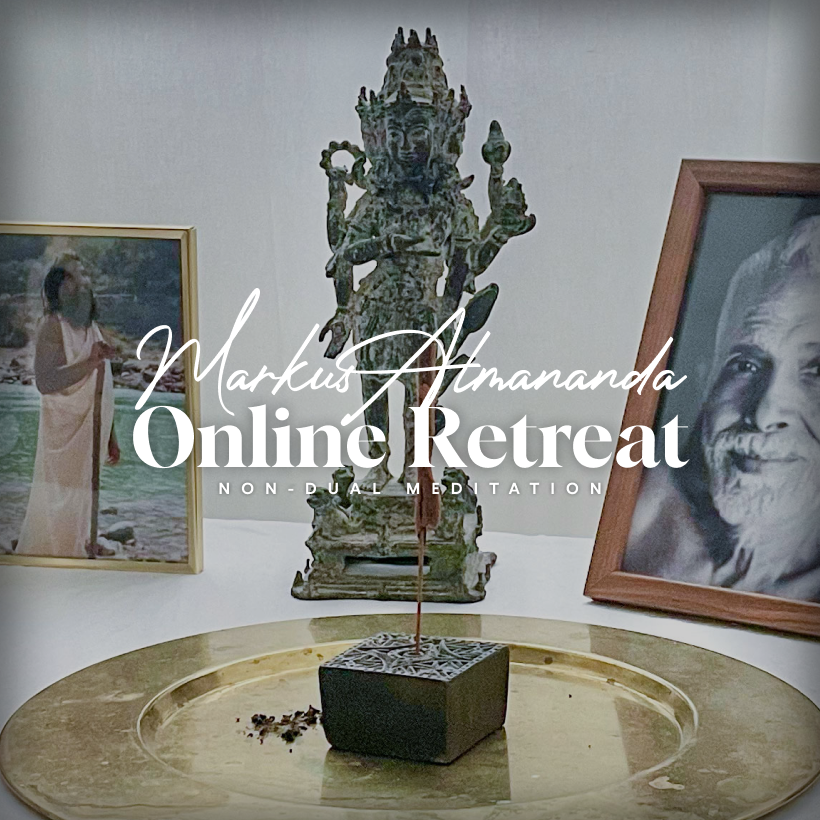
Live Satsang (Non-dual Meditation talk) every Wednesday in Malmö and Online 19.30 – 21.00
A weekend of meditation & self-inquiry
This weekend is an invitation to slow down and turn attention inward.
Through guided meditation, self-inquiry, and shared silence, we explore the simple but profound question of what we truly are beyond thoughts, roles, and habitual identification. The emphasis is not on achieving special states, but on gently noticing what is already present.
The weekend is open to both beginners and those with an established practice. No prior experience of meditation or non-duality is required, only a sincere curiosity and a willingness to look honestly at your own experience.
Satsang Wednedays
An evening of stillness and clarity. Satsang each Wednesday 19:30–21:00
Markus Atmananda invites you to a peaceful evening of meditation, reflection, and open conversation. Together, we explore how to be fully present and discover the natural ease that is already here. You are welcome whether this is your first time meditating or you have years of experience.
Common Questions
What is non-dual meditation?
Non-dual meditation is the resting recognition that your true nature is awareness itself. Not the thoughts, emotions, or sensations that come and go, but the open, changeless presence in which all experience appears.
It is not a practice of becoming something else, nor a path to reach a future state. It is the quiet seeing that you are already the witnessing presence, untouched by the content of experience.
Rather than manipulating the mind or seeking special experiences, non-dual meditation invites you to notice what is always here: the knowing of experience. And then to simply remain as that knowing, without effort, without identification, without resistance.
Over time, this simple yet radical shift from doing to being, from identification to observation, begins to dissolve the illusion of separation and ego. It reveals that there is no difference between you and the world, the seer and seen. Not as a belief, but as a lived truth.
How does non-dual meditation differ from mindfulness or concentration practices?
Non-dual meditation differs from mindfulness and concentration practices in both aim and method.
Mindfulness usually involves paying attention to thoughts, sensations, or the breath in the present moment. Concentration practices train the mind to focus on a single object in order to build clarity and stability. Both of these approaches rely on a subject-object structure: I, the meditator, observe this, the object of meditation.
Non-dual meditation begins where those practices leave off. Rather than placing attention on an object, it gently turns awareness back toward itself. Eventually, even the sense of a separate observer begins to dissolve.
In non-dual meditation, you are not being aware of something. You are resting as awareness. The separation between the one who sees and what is seen starts to fall away. What remains is a simple, undivided presence.
There is no effort to stay in the moment or to still the mind. Instead, there is a quiet relaxing into what has always been here — the open presence in which all experiences come and go.
This does not mean that mindfulness or concentration are wrong. They can be valuable steps on the path. But non-dual meditation reveals what remains when all effort drops away: the effortless being that is not separate from anything.
What is Self-Inquiry?
Atma-Vichara, or Self-Inquiry, is the direct path to realizing your true nature.
It is not about analyzing the personality or improving the mind. It is a focused and silent turning inward by asking, ‘Who am I?’ This question is not meant to lead to a new belief or concept, but to reveal what is always here beneath all ideas.
When a thought, feeling, or identity arises, self-inquiry invites you to ask, Who is this happening to? Who is aware of this? Where is the one who claims to experience this?
Instead of following thoughts outward, you turn attention back to its source. This is not done through effort or strain, but with gentle and steady curiosity. Over time, it becomes clear that the separate ‘I’ cannot actually be found. What remains is the silent awareness in which all experience appears.
Self-inquiry is not a method that leads to awareness. It is the discovery that you already are awareness itself, and that the idea of a separate self was never truly there.
It is not a path in the ordinary sense. It does not take you anywhere. Rather, it reveals that what you are has never been apart from what you are seeking.
How do I integrate non-dual meditation into my daily life?
Non-duality is not something to “apply” to life—it is already here. The mind believes it must adjust itself, shifting between roles, managing life as if it were separate. But who is doing all this adjusting?
Integration happens when you stop interfering. Trust that who you are does not need calibration. Being flows naturally, like water around a stone—it does not need help.
Let life unfold without resistance. The Stillness you seek has never been absent.
Does non-duality mean rejecting the world?
The mind creates the illusion of separation—it sees itself as here and the world as out there. And from this false division, conflict arises. Some believe the world must be rejected to find truth, while others insist on fixing it before turning inward. But both are rooted in the same misunderstanding.
You do not need to reject the world. You only need to see it clearly. The struggle comes from believing in duality—believing that you are separate from life, that there is something “out there” to resist or control. But before trying to change or reject the world, first, come to know yourself.
When the sense of separation dissolves, the question of rejection disappears. The world is not something outside of you—it is part of the same Stillness, the same awareness. Ignorance makes the world seem like an obstacle, but clarity reveals that nothing was ever divided to begin with.
What Is the Difference Between Non-Duality and Vedanta?
Non-duality is not a philosophy or tradition—it is simply what is. It is not something to believe in, study, or practice. It is the direct recognition that awareness is already whole, that nothing is separate, and that truth is not something to attain but what has never been absent.
Vedanta, particularly Advaita Vedanta, is one of the clearest and most direct expressions of non-duality. It provides a framework, scriptures, and teachings that help point to the reality of oneness. Through texts like the Upanishads, the Bhagavad Gita, and the teachings of sages like Adi Shankara and Ramana Maharshi, Vedanta offers a structured way to guide the mind toward realization.
But realization itself is beyond all systems. The words of Vedanta may help undo false identifications, but truth does not belong to any philosophy. Non-duality does not require a tradition—it is not something you learn, but what you are.
How does non-dual meditation deal with devotion?
At first, devotion and non-duality may seem like opposites—one directed toward something higher, the other dissolving all separation. But true devotion is not about worshiping something outside yourself. It is the natural softening of the heart when the illusion of separation fades.
In non-dual meditation, there is no “other” to direct devotion toward. Yet, as the sense of individuality dissolves, what remains is an overwhelming sense of love, reverence, and surrender. Not toward a person, a deity, or an idea, but toward life itself—toward the simple, undeniable presence of being.
True bhakti (devotion) is not about reaching for something distant. It is the recognition that nothing has ever been separate, and in that recognition, love flows effortlessly.
Does Tantra have a role to play in the practice of non-dual meditation?
Tantra, in its essence, is about embracing life fully—seeing everything as an expression of the same awareness. It does not reject the world, the body, or the senses but uses them as pathways to realization. In this way, Tantra can be a powerful complement to non-duality, because it leaves nothing outside of truth.
For many, the idea of non-duality can become abstract—something distant, something to be realized in silence or deep meditation. Tantra brings this recognition into direct experience, showing that Stillness is not separate from movement, that form is not separate from emptiness.
Rather than fighting against thoughts, emotions, or sensations, Tantra allows them to be fully seen, fully felt—until the idea of separation dissolves. Desire, fear, joy, pain—everything can be met with openness, until nothing remains to resist.
But Tantra is not about indulgence. It is about deep intimacy with what is—not avoiding, not grasping, just allowing all things to be what they are, without losing oneself in them. When this is seen, what remains is the same non-dual awareness, untouched and ever-present.
Your non-dual talks are sometimes referred to as Satsangs. What is a Satsang?
The word Satsang comes from Sanskrit—”Sat” means truth, and “Sang” means gathering or association. Traditionally, Satsang refers to sitting in the presence of a teacher or spiritual community, but its deeper meaning goes beyond any physical gathering.
Satsang is not about receiving knowledge or collecting spiritual ideas. It is a space where all illusions are exposed, where the restless mind is invited to stop searching and simply rest in what has always been here.
It is not a meeting of people—it is a meeting with truth itself. Words may be spoken, but the real teaching is not in the words. It is in the Stillness between them, in the direct experience of awareness.
You do not come to Satsang to get something. You come to see that nothing was ever missing.
What is the difference between religion and spirituality?
Religion tells you what the truth is, spirituality asks you to see for yourself. One can give you answers, the other leaves you with no questions.